Play the minor major seventh chord on piano
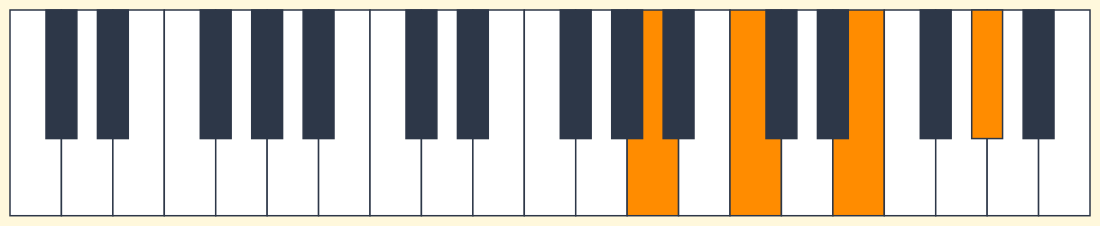
The minor major seventh chord (m(maj7) or mΔ7) combines a minor triad with a major seventh. This combination creates a sound both dark and bright, characteristic of the harmonic minor mode.
Chord composition
| I | ♭III | V | VII |
| Root | Minor third | Perfect fifth | Major seventh |
| 0 | 3 | 7 | 11 |
Formula 1 - ♭3 - 5 - 7
Theory
The m(maj7) chord comes from the harmonic minor scale. C m(maj7) = C-E♭-G-B, A m(maj7) = A-C-E-G♯. The semitone interval between the minor third and major seventh creates distinctive tension. It often appears as a minor tonic chord or in cinematic contexts.
Play the minor major seventh chord on the piano
Styles
Mmaj7 construction
Formula 1 - 3b - 5 - 7: minor triad + major seventh. Example Am(maj7): A - C - E - G#. Mysterious, cinematic color.
Learning
Harmonic minor scale. Im(maj7)-Im7 progressions. Cinematic and dramatic context.
Seventh chord inversions on piano
Seventh chords have 3 inversions (4 notes = 3 possible inversions).
The 3 inversions
- 1st inversion: third in bass (3-5-7-1), noted 6/5. Jazz walking bass.
- 2nd inversion: fifth in bass (5-7-1-3), noted 4/3. Harmonic pedals.
- 3rd inversion: seventh in bass (7-1-3-5), noted 4/2 or 2. Chromatic walking bass, sophisticated resolutions.
In jazz, seventh inversions are essential for smooth voicings and harmonic comping.
How to play
Rare but expressive. Ascending harmonic minor. Film music, bossa nova (Im(maj7)). Unique tension between minor third and major seventh.