Play the major chord on piano
The major chord is a triad composed of three notes: a root, a major third and a perfect fifth. This structure produces a stable and consonant sound, widely used in all musical styles.
Chord composition
| I | III | V |
| Root | Major third | Perfect fifth |
| 0 | 4 | 7 |
Formula 1 - 3 - 5
Theory
The major chord is built by stacking two thirds: a major third (4 semitones) followed by a minor third (3 semitones). This stacking creates a perfect fifth interval (7 semitones) between the root and the fifth. The 1-3-5 formula is universal: C major = C-E-G, D major = D-F♯-A, etc.
Play the major chord on the piano
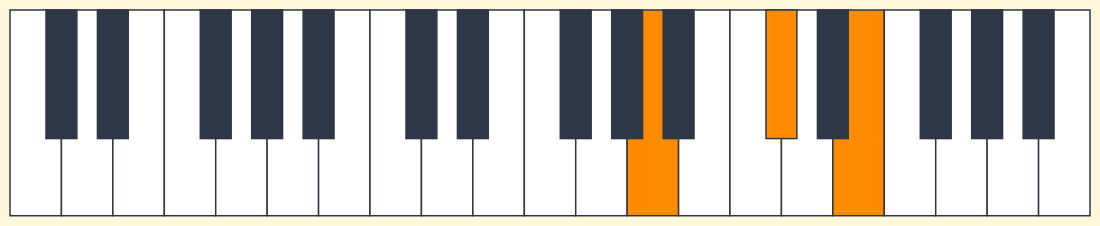
Example: Do Major
Styles
Theoretical construction
Formula 1 - 3 - 5: root + major third (4 semitones) + perfect fifth (7 semitones).
Example C major: C - E - G.
Learning
1) Place fingers slowly 2) Check each string 3) Repeat 10 times 4) Transitions with metronome.
Triad inversions on piano
On piano, inversions are fundamental for creating smooth progressions and avoiding bass leaps.
The 2 possible inversions
- 1st inversion (sixth chord): third in bass (3-5-1), noted I6. Creates melodic bass lines.
- 2nd inversion (six-four chord): fifth in bass (5-1-3), noted I6/4. Used as cadential chord or bass pedal.
Mastering inversions is essential for keyboard harmony: they keep voices close and avoid large leaps between chords.
How to play
Open positions and barres. Fingertips perpendicular to strings.