Play the half-diminished chord on piano
The half-diminished chord (m7♭5 or ø7) combines a diminished triad with a minor seventh. Less tense than dim7, it's essential in minor II-V-I progressions.
Chord composition
| I | ♭III | ♭V | ♭VII |
| Root | Minor third | Diminished fifth | Minor seventh |
| 0 | 3 | 6 | 10 |
Formula 1 - ♭3 - ♭5 - ♭7
Theory
The m7♭5 chord is the seventh degree of the major scale and the second degree of the harmonic minor scale. C m7♭5 = C-E♭-G♭-B♭, D m7♭5 = D-F-A♭-C. It differs from dim7 by its minor seventh (instead of diminished), creating softer tension. The diminished fifth is essential to its sound.
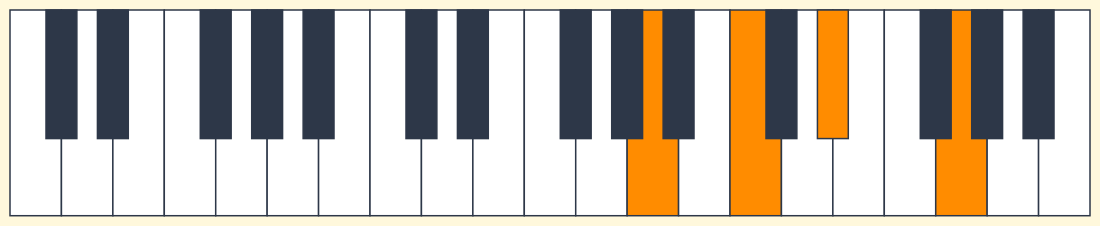
Play the half-diminished chord on the piano
Styles
M7b5 construction
Formula 1 - 3b - 5b - 7b: half-diminished. Example Bm7b5: B - D - F - A. Locrian mode, IIm7b5 in minor (ii-V-i).
Learning
Minor ii-V-i progression: IIm7b5-V7-Im. Locrian mode (7th major degree). Minor jazz and bossa nova.
Seventh chord inversions on piano
Seventh chords have 3 inversions (4 notes = 3 possible inversions).
The 3 inversions
- 1st inversion: third in bass (3-5-7-1), noted 6/5. Jazz walking bass.
- 2nd inversion: fifth in bass (5-7-1-3), noted 4/3. Harmonic pedals.
- 3rd inversion: seventh in bass (7-1-3-5), noted 4/2 or 2. Chromatic walking bass, sophisticated resolutions.
In jazz, seventh inversions are essential for smooth voicings and harmonic comping.
How to play
IIm7b5 in minor progression (Bm7b5-E7-Am). Essential minor jazz. Less tense than dim7, more unstable than m7.