Play the minor chord on piano
The minor chord is a triad composed of a root, a minor third and a perfect fifth. It differs from the major chord by its third lowered by a semitone, creating a darker sound.
Chord composition
| I | ♭III | V |
| Root | Minor third | Perfect fifth |
| 0 | 3 | 7 |
Formula 1 - ♭3 - 5
Theory
The minor chord (notated m or min) is built by stacking a minor third (3 semitones) followed by a major third (4 semitones). The interval between the root and the fifth remains a perfect fifth (7 semitones). C minor = C-E♭-G, D minor = D-F-A.
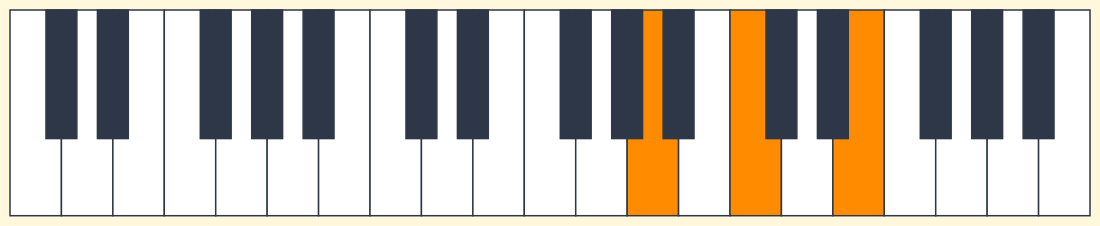
Play the minor chord on the piano
Styles
Construction
Formula 1 - 3b - 5: minor third (3 semitones). Example A minor: A - C - E.
Learning
Comparative approach: play C major then C minor.
Triad inversions on piano
On piano, inversions are fundamental for creating smooth progressions and avoiding bass leaps.
The 2 possible inversions
- 1st inversion (sixth chord): third in bass (3-5-1), noted I6. Creates melodic bass lines.
- 2nd inversion (six-four chord): fifth in bass (5-1-3), noted I6/4. Used as cadential chord or bass pedal.
Mastering inversions is essential for keyboard harmony: they keep voices close and avoid large leaps between chords.
How to play
Am, Em easy positions. Practice major ↔ minor transitions.