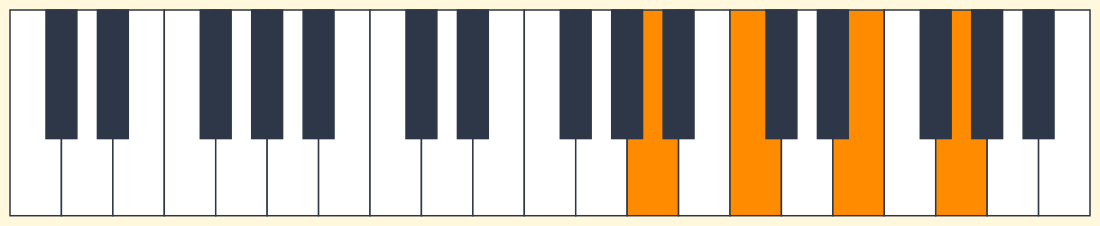
Play the minor seventh chord on piano
The minor seventh chord (m7 or min7) is a four-note chord formed by a minor triad and a minor seventh. It's a widely used chord in jazz and blues.
Chord composition
| I | ♭III | V | ♭VII |
| Root | Minor third | Perfect fifth | Minor seventh |
| 0 | 3 | 7 | 10 |
Formula 1 - ♭3 - 5 - ♭7
Theory
The m7 chord adds a minor seventh (10 semitones) to the minor triad. C m7 = C-E♭-G-B♭, D m7 = D-F-A-C. It's naturally consonant and often serves as a passing chord or IIm7 in II-V-I progressions. The fifth can be omitted in compact voicings.
Play the minor seventh chord on the piano
Styles
M7 chord construction
Formula 1 - 3b - 5 - 7b: minor triad + minor seventh. Example Am7: A - C - E - G. Soft modal color, jazz pillar.
Learning
1) Easy open positions 2) ii-V-I progression (Dm7-G7-C) 3) Dorian mode 4) Funk: syncopated rhythms.
Seventh chord inversions on piano
Seventh chords have 3 inversions (4 notes = 3 possible inversions).
The 3 inversions
- 1st inversion: third in bass (3-5-7-1), noted 6/5. Jazz walking bass.
- 2nd inversion: fifth in bass (5-7-1-3), noted 4/3. Harmonic pedals.
- 3rd inversion: seventh in bass (7-1-3-5), noted 4/2 or 2. Chromatic walking bass, sophisticated resolutions.
In jazz, seventh inversions are essential for smooth voicings and harmonic comping.
How to play
Very accessible open positions (Am7, Em7, Dm7). Used as IIm7 in ii-V-I. Characteristic Dorian mode. Funk: percussive voicings.