Play the major seventh chord on piano
The major seventh chord (maj7 or Δ7) is a four-note chord formed by a major triad and a major seventh. It produces a stable and sophisticated sound.
Chord composition
| I | III | V | VII |
| Root | Major third | Perfect fifth | Major seventh |
| 0 | 4 | 7 | 11 |
Formula 1 - 3 - 5 - 7
Theory
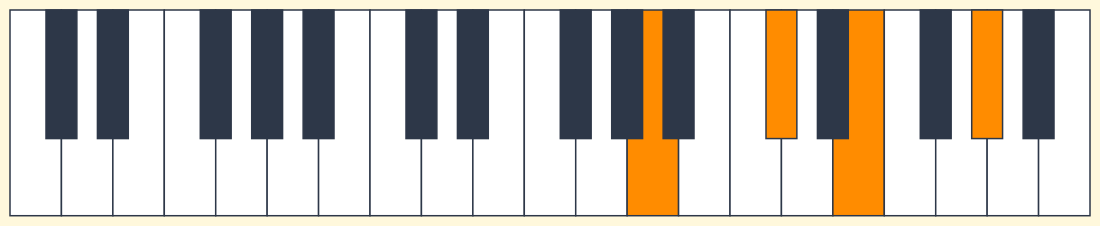
The maj7 chord adds a major seventh (11 semitones) to the major triad. C maj7 = C-E-G-B, D maj7 = D-F♯-A-C♯. Unlike the dominant chord, it contains no tritone and remains consonant. The fifth can be omitted to create a more open voicing.
Play the major seventh chord on the piano
Styles
Maj7 chord construction
Formula 1 - 3 - 5 - 7: major triad + major seventh (11 semitones). Example Cmaj7: C - E - G - B. Sophisticated and stable sound, jazz characteristic.
Learning
1) Compare maj7 vs 7 (C maj7 vs C7) 2) Imaj7-vi-ii-V progressions 3) Jazz ballads 4) Bossa nova (Imaj7-IIm7).
Seventh chord inversions on piano
Seventh chords have 3 inversions (4 notes = 3 possible inversions).
The 3 inversions
- 1st inversion: third in bass (3-5-7-1), noted 6/5. Jazz walking bass.
- 2nd inversion: fifth in bass (5-7-1-3), noted 4/3. Harmonic pedals.
- 3rd inversion: seventh in bass (7-1-3-5), noted 4/2 or 2. Chromatic walking bass, sophisticated resolutions.
In jazz, seventh inversions are essential for smooth voicings and harmonic comping.
How to play
Open positions (Cmaj7, Gmaj7) and barres. Minor second interval between third and major seventh (E-B) creates distinctive color. Jazz: tonic chord (Imaj7).