Play the diminished chord on piano
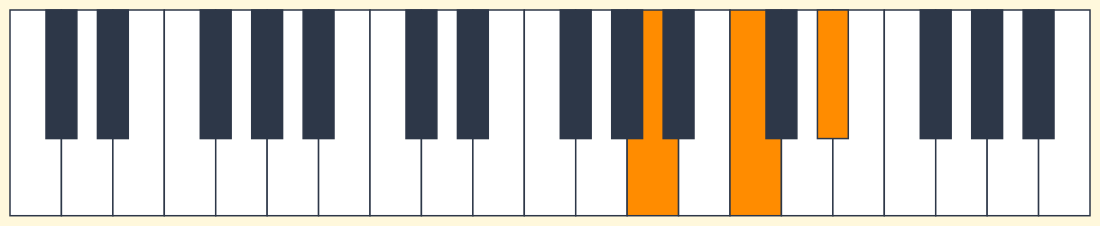
The diminished chord is a triad composed of a root, a minor third and a diminished fifth. Notated dim or °, it creates strong harmonic tension, often used as a passing chord.
Chord composition
| I | ♭III | ♭V |
| Root | Minor third | Diminished fifth |
| 0 | 3 | 6 |
Formula 1 - ♭3 - ♭5
Theory
The diminished chord is built with two successive minor thirds (3 + 3 semitones). The diminished fifth (6 semitones) creates a characteristic dissonance. C diminished = C-E♭-G♭, D diminished = D-F-A♭. This chord is symmetrical: each inversion produces another diminished chord.
Play the diminished chord on the piano
Styles
Construction
Formula 1 - 3b - 5b: diminished fifth (tritone). Tension and instability.
Learning
Practice in resolution context.
Triad inversions on piano
On piano, inversions are fundamental for creating smooth progressions and avoiding bass leaps.
The 2 possible inversions
- 1st inversion (sixth chord): third in bass (3-5-1), noted I6. Creates melodic bass lines.
- 2nd inversion (six-four chord): fifth in bass (5-1-3), noted I6/4. Used as cadential chord or bass pedal.
Mastering inversions is essential for keyboard harmony: they keep voices close and avoid large leaps between chords.
How to play
Compact 3-4 string positions. Chromatic use (C - C#dim - Dm).