Play the dominant seventh chord on piano
The dominant seventh chord, simply notated 7, is a four-note chord formed by a major triad and a minor seventh. It creates strong tension that resolves to the tonic.
Chord composition
| I | III | V | ♭VII |
| Root | Major third | Perfect fifth | Minor seventh |
| 0 | 4 | 7 | 10 |
Formula 1 - 3 - 5 - ♭7
Theory
The dominant seventh chord adds a minor seventh (10 semitones) to the major triad. C7 = C-E-G-B♭, G7 = G-B-D-F. The tritone formed between the third and seventh (E-B♭ in C7) creates dissonance requiring resolution. The fifth is often omitted in tight voicings.
Play the dominant seventh chord on the piano
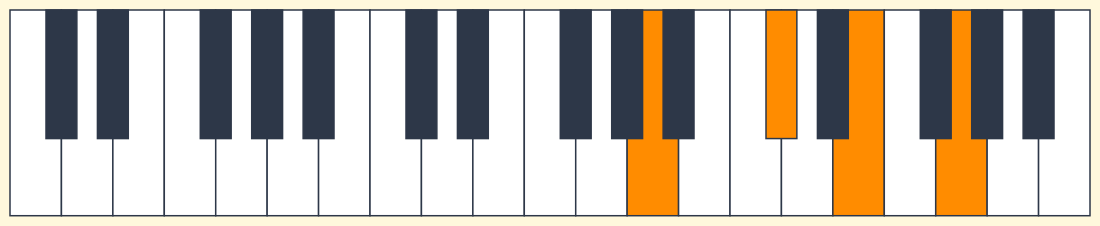
Styles
7th chord construction
Formula 1 - 3 - 5 - 7b: major triad + minor seventh (10 semitones). Example C7: C - E - G - Bb. Minor seventh creates tension requiring resolution.
Learning
1) Master open positions 2) V7-I progressions (G7-C, D7-G) 3) 12-bar blues (I7-IV7-V7) 4) Jazz rootless voicings.
Seventh chord inversions on piano
Seventh chords have 3 inversions (4 notes = 3 possible inversions).
The 3 inversions
- 1st inversion: third in bass (3-5-7-1), noted 6/5. Jazz walking bass.
- 2nd inversion: fifth in bass (5-7-1-3), noted 4/3. Harmonic pedals.
- 3rd inversion: seventh in bass (7-1-3-5), noted 4/2 or 2. Chromatic walking bass, sophisticated resolutions.
In jazz, seventh inversions are essential for smooth voicings and harmonic comping.
How to play
Open positions (E7, A7, D7) and barres. Often used as dominant chord (V7) resolving to tonic. Jazz: rootless voicings.