Bb Major chord on guitar
Position 1
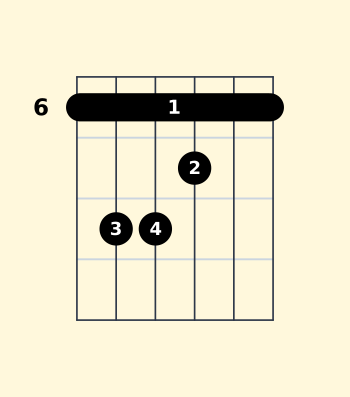
Position 2
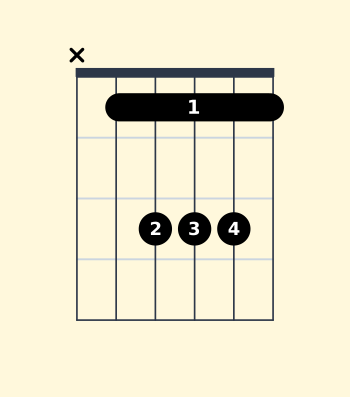
Chord composition
| I | III | V |
| Root | Major third | Perfect fifth |
| Bb | D | F |
ALL ABOUT THE BB MAJOR CHORD
Chord Composition
The Bb Major chord is composed of 3 notes :
- Bb (Root)
- D (Major third)
- F (Perfect fifth)
These notes form a major triad, characterized by its bright and stable sound.
How to play Bb Major on guitar
Several positions exist to play the Bb Major chord on guitar. The diagrams above show the most common positions:
- Open position: uses open strings, ideal for beginners. It's the easiest position to master when starting out.
- Barre position: movable across the entire neck, allows playing in different keys. Requires more hand strength but offers great flexibility.
- High positions: clearer and brighter tones, used in jazz and modern music. Facilitate solos and melodic transitions.
To master the Bb Major chord, start with the open position, making sure each string rings clearly. Practice chord changes with a metronome to develop fluidity. Beginner guitarists should focus on one position before exploring variants.
Tips for beginners
If you're beginning to learn the Bb Major chord on guitar, here are some practical tips:
- Curve your fingers well to avoid touching adjacent strings and muting the sound
- Press firmly but without excessive tension in your hand - strength will come with practice
- Place your fingers slowly at first, speed will develop naturally over time
- Check each string individually before strumming the entire chord
- Use a metronome to develop regularity in your chord changes
- Practice 15-20 minutes daily rather than one long weekly session
Common mistakes to avoid
When learning Bb Major, beginners often make these mistakes:
- Flat fingers: prevents other strings from ringing properly. Keep your fingers perpendicular to the neck.
- Overly tense hand: can cause pain and slow your progress. Stay relaxed.
- Position too far from frets: generates muted notes or unpleasant buzzing.
- Poorly positioned thumb: a thumb too high on the neck reduces finger pressure strength.
Transitions and exercises
The key to mastering Bb Major lies in smooth transitions to other chords. Practice these essential progressions by playing each chord for 4 beats to a metronome (start at 60 bpm):
- Identify pivot fingers that stay in place during the change
- Mentally visualize the next position before moving your fingers
- Gradually increase the tempo once movements are mastered
Popular chord progressions with Bb Major
The Bb Major chord naturally integrates into several common progressions in popular music:
- I-IV-V progression: the basis of blues and classic rock. This progression has been ubiquitous since the 1950s.
- I-V-vi-IV progression: omnipresent in modern pop, used in countless hits. Found in "Let It Be", "Don't Stop Believin'" and hundreds of other songs.
- I-vi-IV-V progression: classic from the 50s-60s, basis of rock'n'roll and doo-wop.
- Perfect cadence (V-I): fundamental harmonic resolution that creates a satisfying sense of conclusion.
These progressions constitute the basic harmonic vocabulary of modern Western music. Mastering these progressions with Bb Major will allow you to play thousands of songs.
Usage by musical style
Rock and Pop: the Bb Major chord is generally played with energetic strumming. It's very present in power ballads from the 80s and 90s.
Folk and Country: exploits open strings in fingerpicking, creating rich and resonant arpeggios characteristic of the genre.
Blues: the chord can be transformed into a seventh to create the characteristic tension of 12-bar blues.