E Diminished chord on guitar
Position 1
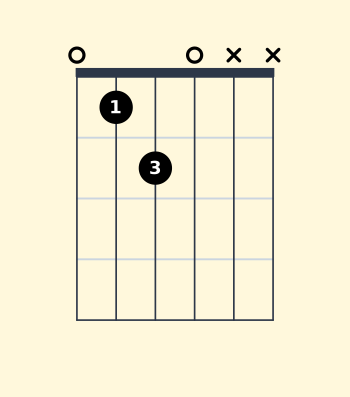
Position 2
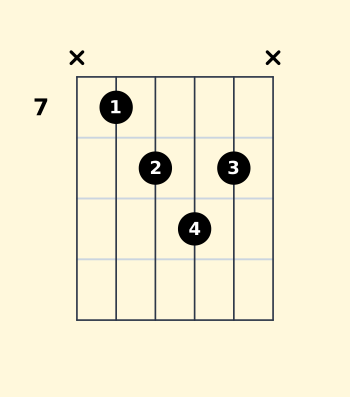
Chord composition
| I | ♭III | ♭V |
| Root | Minor third | Diminished fifth |
| E | G | A# |
ALL ABOUT THE E DIMINISHED CHORD
Chord Composition
The E Diminished chord is composed of 3 notes :
- E (Root)
- G (Minor third)
- A# (Diminished fifth)
These notes form a diminished triad, creating a tense sonority requiring resolution.
How to play E Diminished on guitar
The E Diminished diminished chord is an unstable chord that creates strong harmonic tension. It consists of a minor third and a diminished fifth.
- Partial positions: often played on 3 or 4 strings to avoid too dense a sonority
- Passing function: mainly used as a transition chord between two stable chords
- Tension and resolution: the diminished chord naturally calls for resolution to a consonant chord
The diminished chord is symmetrical: each note is separated from the next by a minor third (1.5 tones). This particularity makes the chord very harmonically versatile.
Harmonic usage
The diminished chord serves several functions:
- Passing chord: between the tonic and second degree, or between the fourth and fifth
- Substitution: can replace a dominant seventh chord
- Modulation: facilitates key changes thanks to its harmonic ambiguity
Common uses of E Diminished
The E Diminished diminished chord is mainly used as a passing chord:
- Between I and ii: creates a smooth chromatic ascent
- Between IV and V: reinforces the cadence by adding tension
- Dominant substitution: replaces V7 in certain jazz contexts
Musical styles
Jazz and Blues: heavily used to enrich standard progressions.
Classical music: passing chord or modulation function.
Pop and Rock: creates dramatic effects in emotional passages.