Bb Dominant Seventh chord on charango
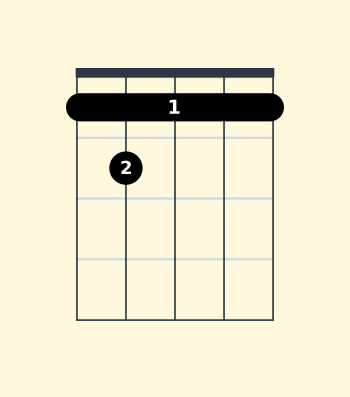
Chord composition
| I | III | V | ♭VII |
| Root | Major third | Perfect fifth | Minor seventh |
| Bb | D | F | Ab |
ALL ABOUT THE BB DOMINANT SEVENTH CHORD
Chord Composition
The Bb Dominant Seventh chord is composed of 4 notes :
- Bb (Root)
- D (Major third)
- F (Perfect fifth)
- Ab (Minor seventh)
These notes form a dominant seventh chord, adding tension and harmonic movement.
How to play Bb Dominant Seventh on charango
The Bb Dominant Seventh dominant seventh chord is fundamental in blues, jazz and rock. It adds tension that calls for resolution.
- Open position: rich positions with open strings, ideal for blues
- Barre position: movable across the entire neck for all keys
- Partial voicings: by omitting the fifth, you get a more compact and modern sound
The minor seventh creates a characteristic dissonance that defines the sound of blues and jazz. Mastering this chord is essential for these styles.
Specific techniques
For 7th chords on charango:
- Bends and slides: use these techniques to add expressiveness, typical of blues
- Rootless voicings: in jazz, omit the root for a more sophisticated sound
- Tritone substitution: replace with another 7th chord at tritone distance
Common uses of Bb Dominant Seventh
The Bb Dominant Seventh chord plays a key role in functional harmony:
- Dominant function: creates tension that naturally calls for resolution to the tonic. This is the basic principle of tonal harmony.
- 12-bar blues: characteristic 7-7-7 structure where all chords are sevenths. This sonority defines traditional blues.
- Jazz and ii-V-I progressions: enriches cadences with sophisticated harmonic colors. The ii-V-I is the DNA of jazz.
- Rock and rock'n'roll: 7th riffs define the sound of the 50s-60s
Musical styles
Blues: absolutely fundamental - 12-bar blues relies entirely on dominant seventh chords.
Jazz: sevenths are enriched with extensions (#9, b9, #11, b13) to create complex colors.
Rock'n'roll: the 50s heavily relied on sevenths for that retro, danceable sound.
Funk and Soul: used in syncopated grooves, creating a rich and rhythmic harmonic foundation.