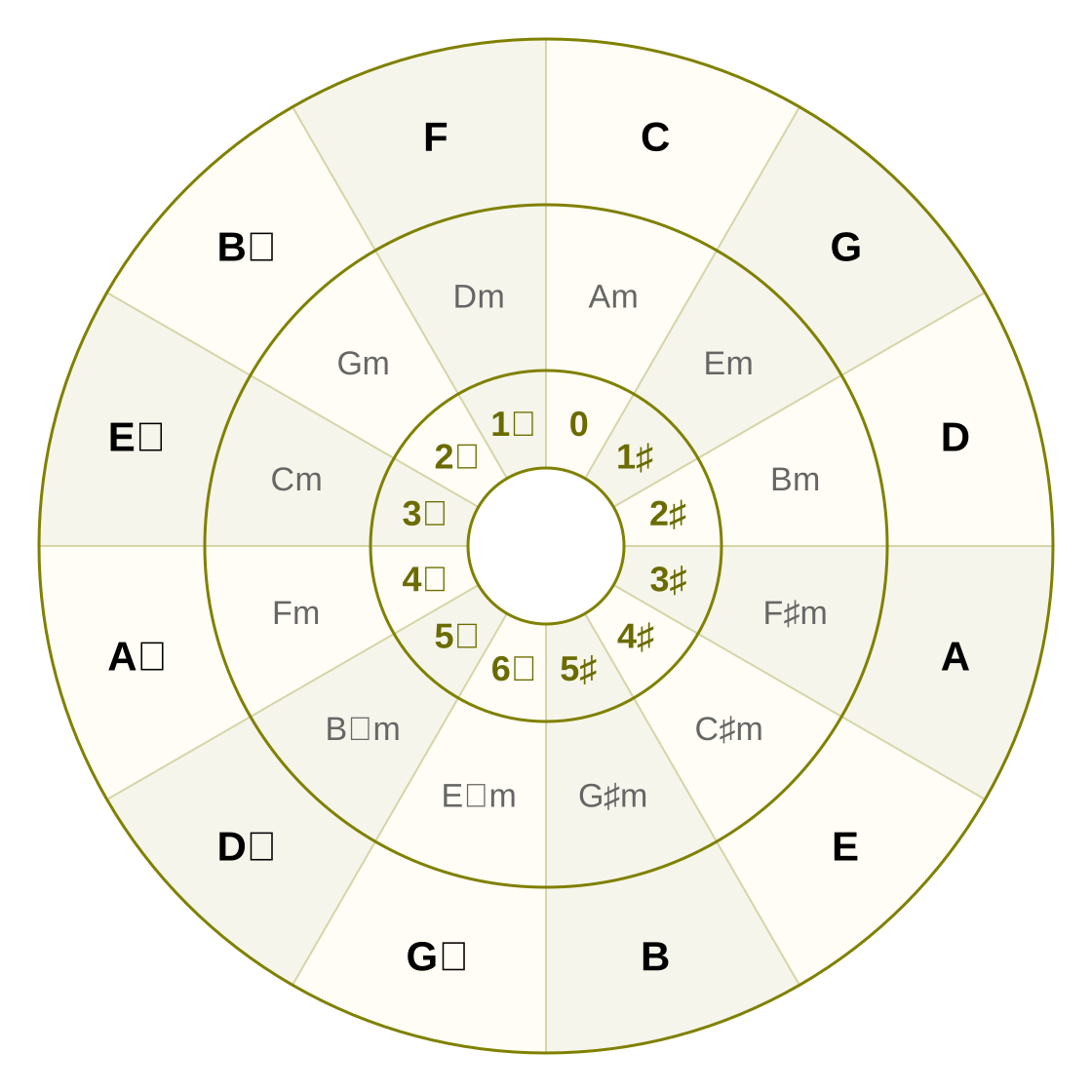
The circle of fifths, also called the cycle of fifths or wheel of fifths, represents one of the most valuable tools in music theory. This graphic representation illustrates the relationships that exist between the twelve notes of the chromatic scale, their associated key signatures, and their respective tonalities. A true cornerstone of musical understanding, the circle of fifths allows musicians of all levels and all instruments to navigate with ease through the universe of keys, scales, and harmonic progressions.
Whether you are a pianist, guitarist, violinist, or singer, mastering the circle of fifths opens the doors to a deep understanding of music. This visual tool synthesizes in a single diagram information that would otherwise require long hours of memorization.
What is the Circle of Fifths?
The circle of fifths is a circular representation that organizes the twelve notes of Western music according to their intervallic relationship of a perfect fifth. In music theory, a perfect fifth represents an interval of seven semitones, or five notes of the diatonic scale.
This circular organization is not arbitrary: it reveals the natural connections that unite different tonalities with each other. The circle of fifths shows how each key shares almost all of its notes with its immediate neighbors, thus creating a smooth harmonic transition from one key to another.
The circle of fifths diagram generally consists of three concentric circles that provide complementary information: the outer circle presents the major keys, the intermediate circle indicates the relative minor keys, and the central circle displays the number of accidentals (sharps or flats) for each key, which is called the key signature.
The Construction of the Circle of Fifths
The construction logic of the circle of fifths is based on a simple yet elegant mathematical principle. Starting from any note and successively adding a perfect fifth (seven semitones), we travel through all twelve notes of the chromatic scale before returning to the starting note.
Clockwise Direction: Progression by Fifths
When we traverse the circle of fifths clockwise, we progress by intervals of ascending fifths. For example, starting from C, we get G, then D, then A, and so on. This progression adds one sharp at each step: C major has no accidentals, G major has one sharp (F#), D major has two (F# and C#), and this logic continues around the circle.
Counterclockwise Direction: Progression by Fourths
Conversely, when we move counterclockwise, we progress by intervals of ascending fourths (or descending fifths, which amounts to the same thing). From C, we reach F, then B♭, then E♭, and so on. This time, each step adds one flat to the key signature: F major has one flat (B♭), B♭ major has two (B♭ and E♭), and the sequence continues.
The Meeting Point: The Enharmonic Zone
At the bottom of the circle of fifths, we find a zone where sharp and flat keys meet. F# major (six sharps) and G♭ major (six flats) are enharmonic, meaning they sound identical on most instruments, although they are written differently.
Information Contained in the Circle of Fifths
Major and Minor Keys
The outer circle of the circle of fifths presents the twelve major keys. Each major key has a relative minor key, displayed in the intermediate circle, which shares exactly the same key signature. This relationship between relative major and minor is fundamental in music theory: the relative minor key is always located a minor third (three semitones) below its relative major.
For example, C major and A minor share the same key signature (no accidentals), G major and E minor both have one sharp, and F major and D minor have one flat.
Key Signatures and Accidentals
The central circle of the circle of fifths indicates the number and type of accidentals for each key. This information is crucial for quickly identifying a key or transposing a piece. A key signature corresponds to the accidentals that appear at the beginning of a score, just after the treble or bass clef.
The progression is perfectly regular: starting from C (no accidentals) and moving clockwise, each key adds one sharp. Moving counterclockwise from C, each key adds one flat. This mathematical regularity makes the circle of fifths a particularly effective mnemonic tool.
The Order of Sharps and Flats
The circle of fifths also reveals the order in which sharps and flats appear. Sharps are added in the order F#, C#, G#, D#, A#, E#, B# (the order of the cycle starting from F). Flats follow the reverse order: B♭, E♭, A♭, D♭, G♭, C♭, F♭ (the order of the cycle starting from B and moving counterclockwise).
Practical Applications of the Circle of Fifths
Identifying and Transposing Keys
One of the primary uses of the circle of fifths is to identify the key of a piece. By observing the key signature of a score, it is sufficient to locate the corresponding number of accidentals on the circle to instantly determine the major key and its relative minor.
The circle of fifths also facilitates transposition, which consists of moving a piece from one key to another. By visualizing the distance between two keys on the circle, one can quickly calculate the necessary transposition interval and anticipate the new accidentals.
Understanding Harmonic Progressions
The circle of fifths reveals the most natural and satisfying chord progressions for the ear. Chord movements that follow the cycle counterclockwise (by descending fifths or ascending fourths) create a strong sense of harmonic resolution. This is why so many pieces use progressions like ii-V-I or vi-ii-V-I, which precisely follow this circle logic.
In classical music as in jazz, in rock as in pop, composers rely consciously or unconsciously on the circle of fifths to build coherent and effective chord sequences. Understanding this logic allows one to analyze the harmonic structure of pieces and compose with greater mastery.
Building and Memorizing Scales
The circle of fifths offers a systematic method for building any major or minor scale. By knowing that a particular key has a certain number of sharps or flats, and knowing the order in which these accidentals appear, one can mentally reconstruct any scale without brute memorization effort.
This structured approach advantageously replaces learning each scale individually by heart. Instead of memorizing twelve major scales and twelve minor scales separately, the musician integrates a logical system that automatically generates all this information.
Modulation and Key Changes
When a composer wishes to change key during a piece (a technique called modulation), the circle of fifths guides toward the most musical choices. Neighboring keys on the circle, which differ by only one accidental, offer smooth and natural modulations. Diametrically opposed keys on the circle create more pronounced and dramatic contrasts.
Four Ways to Read the Circle of Fifths
The circle of fifths can be interpreted in four different ways depending on the musical context:
As a system of keys: each position represents a complete key with its key signature and specific harmonic color.
As a sequence of scales: each position indicates a major or minor scale with its constituent notes.
As a circular chromatic scale: positions can simply represent the twelve notes of Western music, independent of any tonal context.
As a series of chords: each position can represent a fundamental chord (major, minor, or other) used in a harmonic progression.
This versatility makes the circle of fifths a truly universal tool, capable of adapting to the specific needs of each musician and each musical situation.
The circle of fifths transcends instruments, musical styles, and skill levels. Whether you are beginning your musical learning or are an experienced instrumentalist, this circular diagram remains a valuable companion for understanding the fundamental organization of Western music.
Much more than a simple memory aid for key signatures, the circle of fifths reveals the deep relationships between keys, explains the logic of harmonic progressions, and provides a conceptual framework for composition, improvisation, and musical analysis. By integrating this tool into your daily practice, you will develop an intuitive understanding of music theory that will considerably enrich your experience as an instrumentalist.
Learning the circle of fifths represents a modest investment in time for considerable and lasting benefits in your musical journey. Take the time to familiarize yourself with its structure, its internal logic, and its multiple applications: you will quickly discover that this theoretical tool transforms your relationship with music, making accessible what once seemed complex or mysterious.